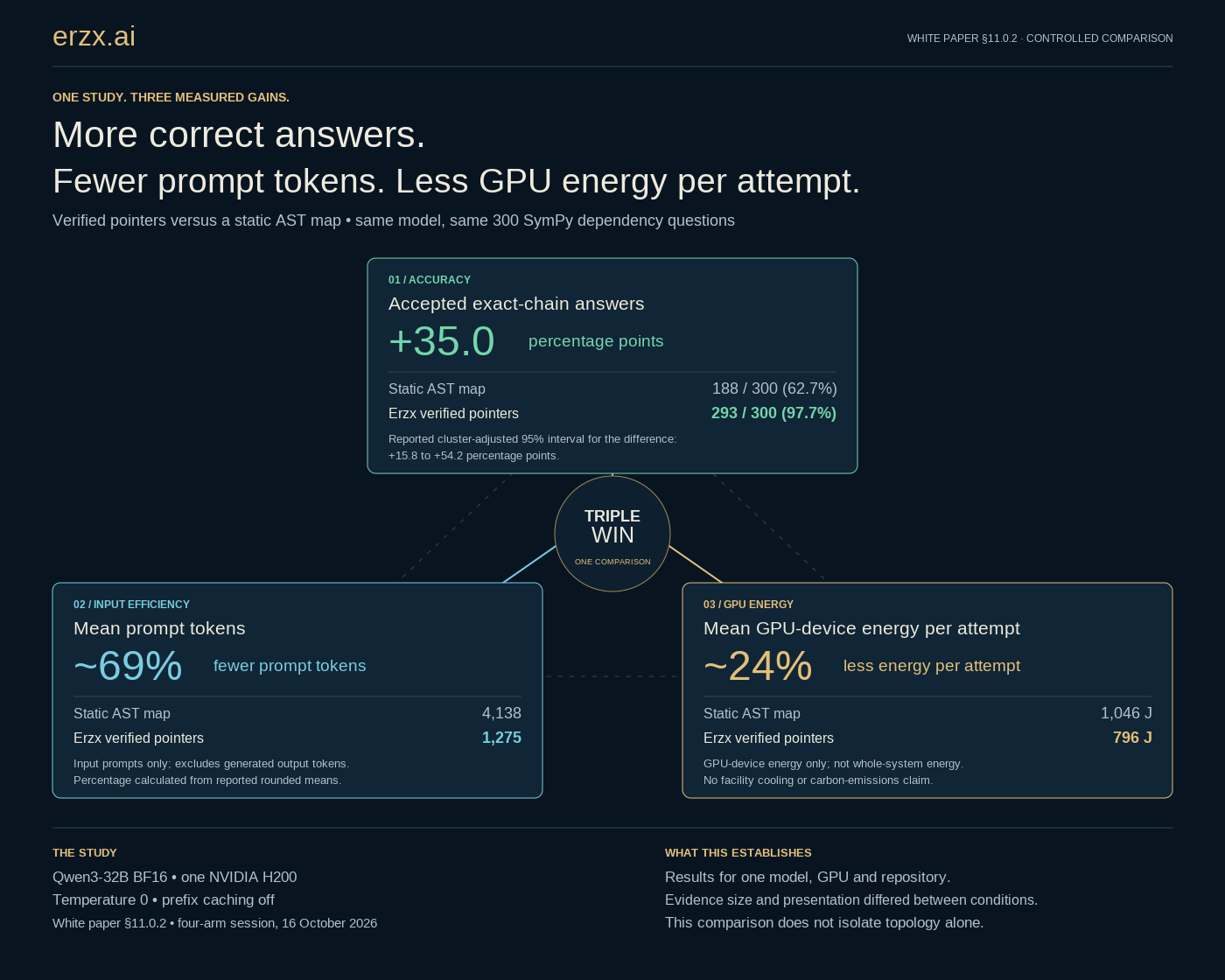
Prompt tokens only; excludes generated decode tokens. Net delta: −2,863.
COMPUTE ENERGY
Mean GPU Energy per Attempt
~24%
less GPU-device energy
Static AST map (Baseline)1,046 J
Erzx verified pointers796 J
On-device joules per attempt; excludes facility cooling & PUE. Net delta: −250 J.
Where the gains stop
The three headline numbers belong to the same four-arm session. They are not a prediction for another model or workload, and they do not measure a trained native Erzx model.
Energy accounting. The reported quantity is mean GPU-device energy per attempt, including unsuccessful attempts. It excludes retrieval and setup costs, host CPU work, query embedding and one-time index construction. No physical energy-calibration or end-to-end energy-payback claim is established here. It is not whole-host, idle-inclusive deployment or facility energy; cooling and carbon savings were not measured here.
Other studies show trade-offs. In separate comparisons against 4,000-token dense retrieval (§11.0), verified pointers used more GPU energy per question on Qwen2.5-7B (218 versus 146 J) and gpt-oss-120b (916 versus 548 J). Those dense comparators returned no complete answers and generated very little output. These examples are separate studies, not additional arms or denominators for the headline comparison.
Deployment economics. These GPU-device measurements do not establish end-to-end deployment savings or a reduction in a customer’s bill. A scoped comparison must account for the selected workload, accepted outcomes and full operating costs.
These differences are why a Comparative Pilot measures your selected model, workload and success criteria before any operating benefit is promised.
ADDITIONAL STUDIES / DISTINCT FROM THE HEADLINE COMPARISON
Different questions. Separate evidence.
WHITE PAPER §6.7 / CONVERSATION RETRIEVAL
DCTCS: revisiting earlier discussions
In the eight-H200 collection, DCTCS revision 5.3 received 1,283/2,430 strict R3 passes (52.8%) versus 438/2,430 (18.0%) for metadata-filtered RAG on assigned QA A2+A3 views. The descriptive difference is 34.8 percentage points.
Matched QA selected-path reader totals were 3,008,756 input-plus-output tokens for DCTCS and 7,487,934 for RAG: 59.8% fewer. These include the selected initial request, primary follow-up and embedded recovery where present. Other follow-up scenarios, failed attempts and evidence-construction work are excluded. This is neither total-system work nor measured energy savings.
Scoring and limits. R3 is the frozen strict automatic score. A separate R4 scoring-instrument repair, applied to retained unresolved answers, reports 1,920 versus 656 passes; it is not another model run and does not replace R3. Semantic adjudication and planned inference remain open, alongside unresolved outcomes and timeout/budget deviations.
Earlier-revision comparison. Revision 5.3 did not improve every endpoint against the same-H200 revision 5.2 control: strict factual-retrieval passes were 1,283 versus 1,375, and changed-post strict passes were 68/180 versus 134/180. The headline here concerns the tested RAG comparator.
Separate RTX 5080 study
Revision 5.2 on the RTX 5080 received 1,356/2,430 automatic factual-retrieval passes (55.8%) versus 421/2,430 (17.3%) for metadata-filtered RAG across 60 synthetic conversation families. These are descriptive retained grades, not a completed inferential or semantic-adjudication verdict.
In that collection, reader-token totals were 7,417,401 for DCTCS, 7,538,506 for RAG and 220,819,449 for full-transcript reading. The approximately 29.8-fold reduction is against full-transcript reading, not RAG. This RTX 5080 collection is not pooled with the H200 collection; no device-energy saving is inferred.
WHITE PAPER §11.0.2 / SEPARATE CONCURRENT-SERVING BLOCK
Useful throughput under 16-user demand
Qwen3-32B on one NVIDIA H200 served 16 concurrent requests with prefix caching enabled. The experiment used 18 interleaved fresh-server segments: six per arm, each with five steady windows targeted at 30 seconds, giving 30 steady windows per arm.
Under the frozen steady-window estimator, verified pointers delivered 4.06 times the exactly correct answers per second of the static AST map: 4.57 versus 1.13/s, with a one-sided 97.5% lower bound of 4.03. An independent recomputation using a different binning convention gives 4.02; its point estimate and the frozen estimator’s bound are not combined.
Post hoc energy analysis. In the same serving block, GPU-device energy per correct answer was 145.5 versus 606.8 J, approximately 76% lower. This is a per-correct-answer result on repeated workloads, separate from the homepage’s 796 versus 1,046 J per-attempt comparison. It does not measure facility energy or customer-bill savings.
Scope. One reader, one GPU and the specified SymPy workload. The concurrent block has prefix caching enabled; the single-stream headline comparison has it disabled. Neither experiment is substituted for the other, and no DCTCS outcome is attached to these energy figures.
Status: Figures verified against manuscript (§11.0.2). The figures match the source manuscript and both reviewers’ numeric assessments. Fresh raw-data recomputation remains unavailable. This is manuscript consistency review, not scientific certification or publication approval.