RELATED INFORMATION
The pieces are present.
A collection of relevant passages can mention all three without making their dependency clear.
KNOWLEDGE, GIVEN STRUCTURE.
Connect what is known.
Bring the right depth to the question.
Make the evidence count.
Erzx explores a different foundation for language models: knowledge with explicit relationships, conversation with continuity, and answers accountable to their supporting evidence.
Research architecture · selected components tested

It needs the right knowledge, the relationships that make it meaningful, and a clear account of what remains uncertain.
Think of the difference between a shelf of books and an explanation that connects the exact pages you need. Erzx investigates how to make those connections explicit—and how to put them to work with a language model.
What changes when a model receives the structure a task actually needs?
See a simple example ↓FROM INFORMATION TO UNDERSTANDING
A simple illustration—not a benchmark. Imagine asking whether a plan can proceed when one of its prerequisites is still unresolved.
“Are we ready to proceed?”
RELATED INFORMATION
A collection of relevant passages can mention all three without making their dependency clear.
EXPLICIT RELATIONSHIPS
The question is now specific: is the required approval supported by the available evidence?
Erzx’s research asks whether explicit prerequisites improve the evidence supplied to a model. This illustration does not demonstrate general reasoning accuracy or guarantee a particular answer.
THE ARCHITECTURAL AMBITION
Represent depth and supported relationships, so that finding a passage is the beginning of an explanation.
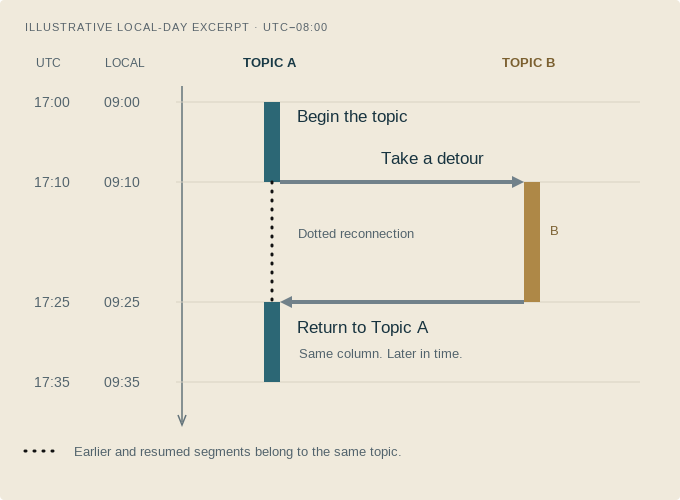
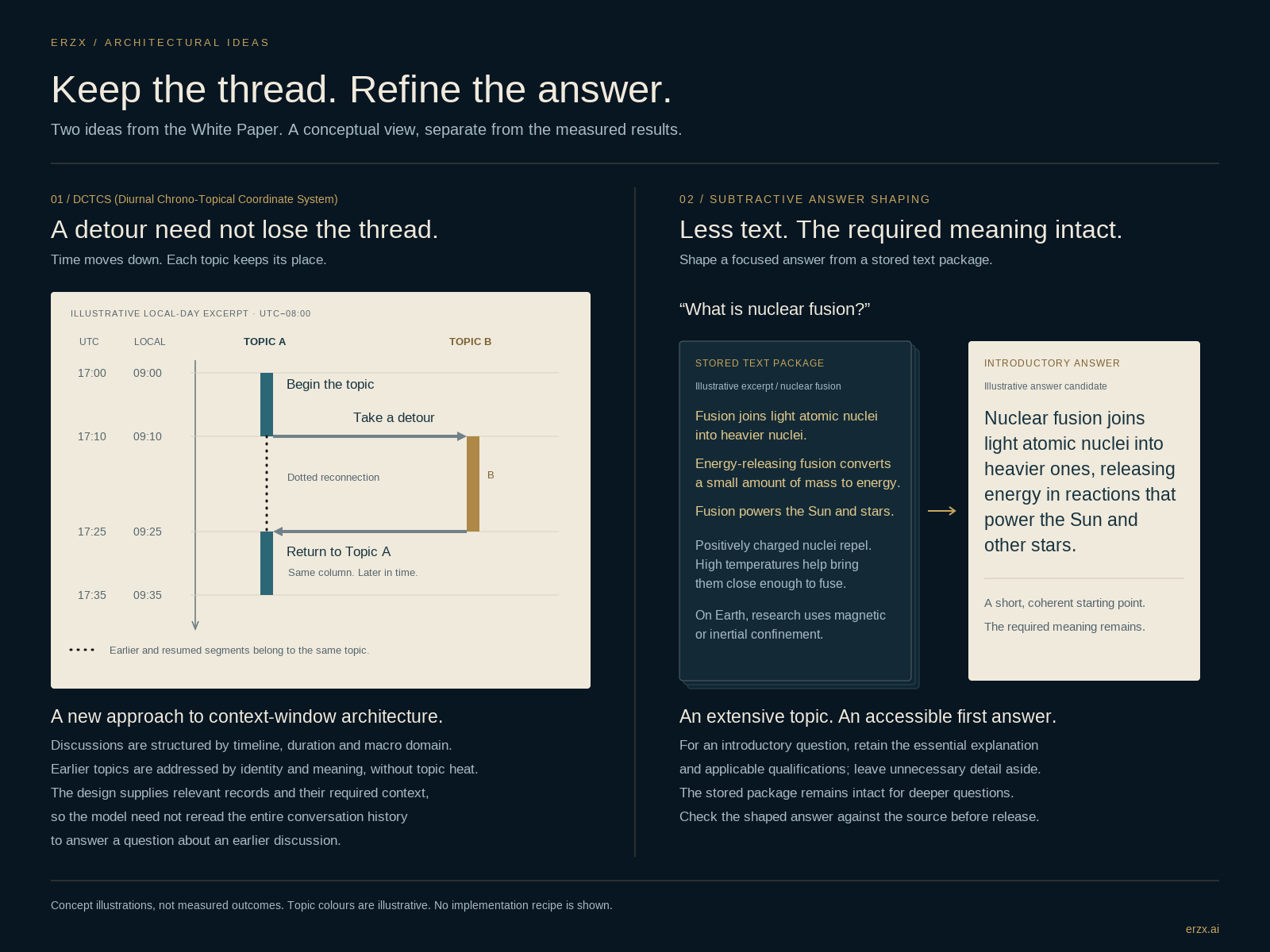
Investigate how the relevant history of a conversation can remain useful as the work develops.
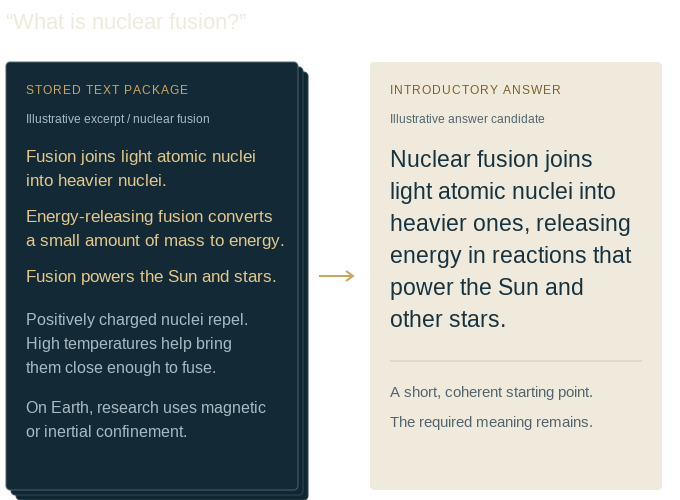
Keep sources, conditions and gaps in view when constructing and checking an answer.
These are connected design objectives. Evidence for individual components remains separate from validation of the complete architecture.
02 / THE STRUCTURE BEHIND THE IMAGE
The honeycomb gives the idea a visual language: connected domains across a surface, and increasing depth beneath it. It is an invitation to explore the architecture.
The design arranges knowledge in ten depth positions within a domain. Its sub-layer profile follows a Fibonacci progression.
1 · 2 · 3 · 5 · 8 · 13
21 · 34 · 55 · 89
Depth describes organization. It does not, by itself, establish truth, confidence or a performance advantage.
Open the full structure drawing ↗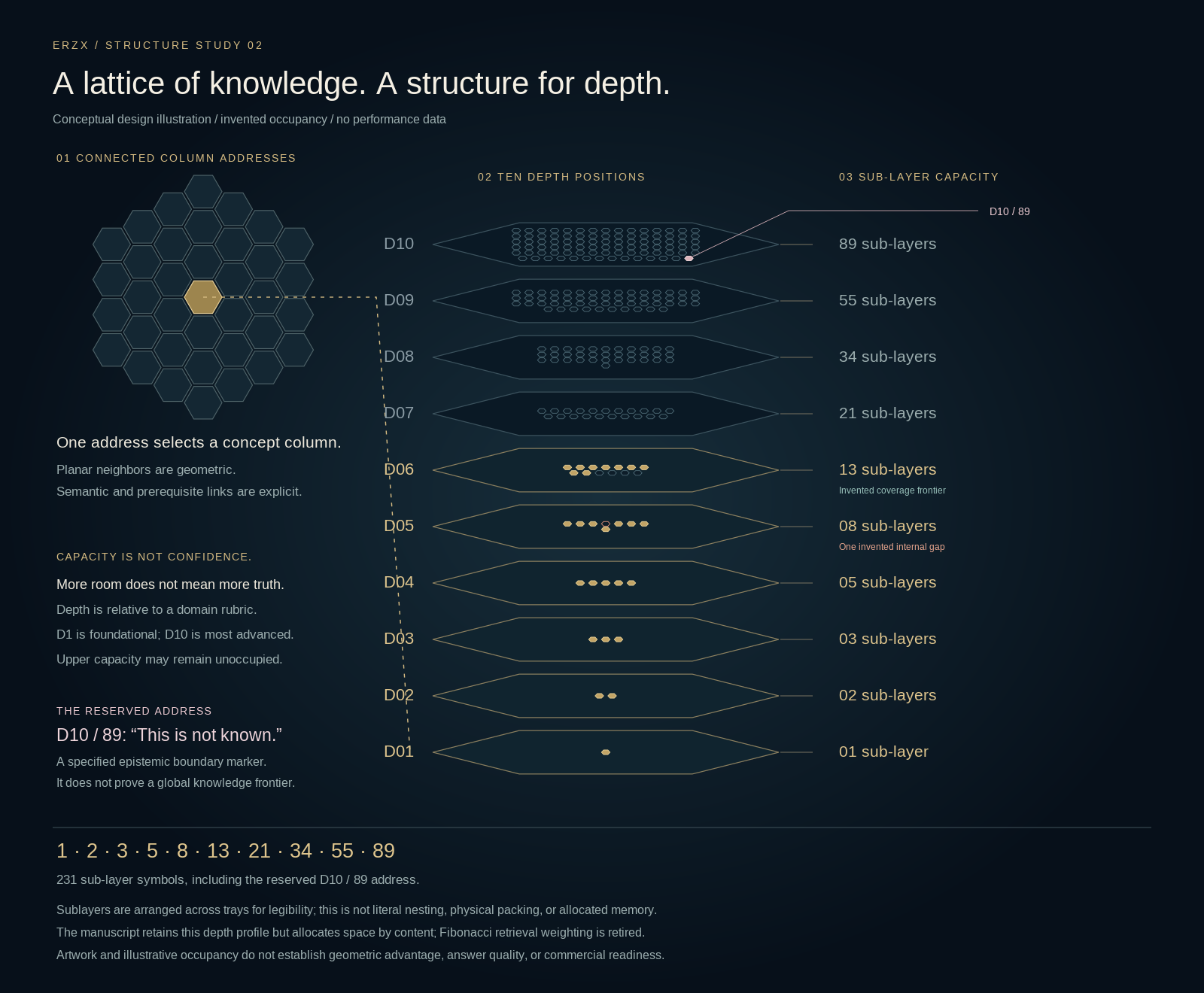
The ten depth positions run from D1 (foundational) to D10 (most advanced within a domain rubric), with sub-layer capacities of 1, 2, 3, 5, 8, 13, 21, 34, 55 and 89. The drawing contains 231 sub-layer symbols, including the reserved D10 / 89 address, “This is not known.” This marker does not establish a global knowledge frontier.
Occupied cells, unoccupied capacity, an internal gap and a coverage frontier are illustrative, not measured. Sublayers are shown across trays for legibility, not as literal nesting or allocated memory. Space is allocated by content; Fibonacci retrieval weighting is retired.
Horizontal cells suggest domains; columns suggest depth; finer chambers suggest increasingly elaborate representations. Semantic relationships must be recorded explicitly. The geometry is an artistic interpretation, not a physical memory layout or a measured result.
The drawing communicates a proposed organizational structure. A commercial comparison must separately test the selected implementation, model, workload and resource budget. Neither Fibonacci proportions nor visual depth establish a benefit on their own.
03 / THREE MEASURED GAINS
In one comparison, Erzx verified pointers increased accepted exact-chain answers while reducing mean prompt tokens and GPU-device energy per attempt.
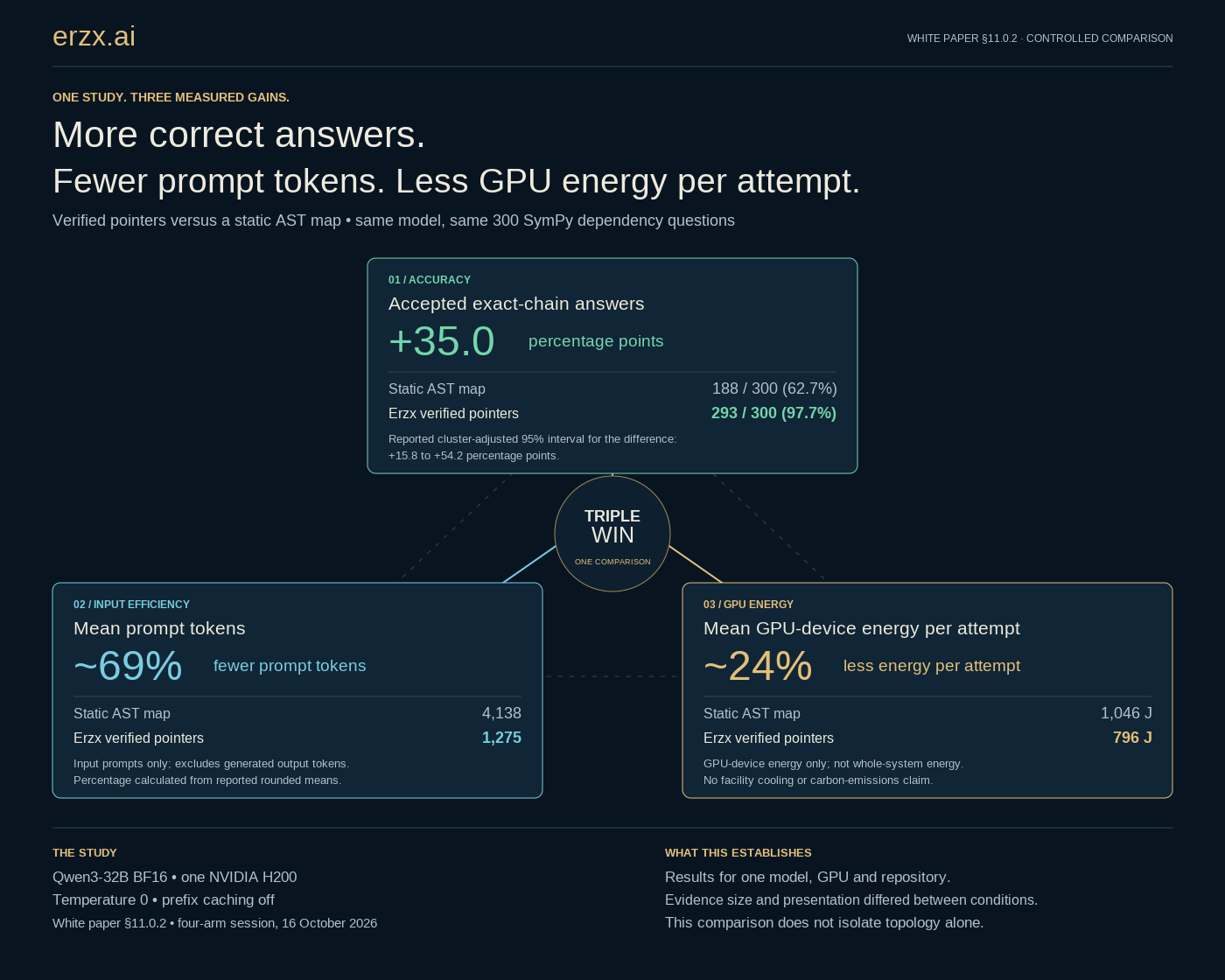
01 / ACCEPTED EXACT-CHAIN ANSWERS
293 / 300 with verified pointers
188 / 300 with the static AST map.
97.7% versus 62.7%. Reported cluster-adjusted 95% interval for the difference: +15.8 to +54.2 percentage points.
02 / MEAN PROMPT TOKENS
1,275 with verified pointers
4,138 with the static AST map.
Input prompts per attempt; excludes generated output tokens. Percentages use reported rounded means.
03 / MEAN GPU-DEVICE ENERGY
796 J with verified pointers
1,046 J with the static AST map.
Includes unsuccessful attempts. GPU-device energy only; no facility cooling or carbon-emissions claim.
Open the full comparison graphic ↗
Same Qwen3-32B BF16 model, one NVIDIA H200, 300 SymPy dependency questions per arm; temperature 0, prefix caching off. White Paper §11.0.2, four-arm session. Reported cluster-adjusted 95% interval for the accuracy difference: +15.8 to +54.2 percentage points. Results are specific to this workload; evidence size and presentation differed, so the comparison does not isolate topology alone. GPU energy excludes whole-system and facility energy.
Other tested models used more GPU energy per question with pointers. The results page explains these trade-offs and the excluded CPU, embedding and index-building costs.
Inspect the comparison and its limits →FURTHER EVIDENCE / SEPARATE EXPERIMENTS
Two further lines of research, each with its own workload, comparator and measurement boundary.
CONVERSATION RETRIEVAL / DCTCS
Strict factual-retrieval pass share
DCTCS revision 5.3 received 1,283 of 2,430 strict passes, versus 438 of 2,430 for metadata-filtered RAG in the H200 collection.
59.8% fewer selected-path reader tokens in the same collection: input plus output, under the reported accounting boundary.
Descriptive automatic scores; adjudication and inferential review remain open. Some endpoints regress against the earlier H200 revision. No DCTCS energy saving is claimed.
Study context and limits →CONCURRENT SERVING / 16 USERS
Verified pointers versus static AST map
With Qwen3-32B on one H200, verified pointers delivered 4.57 versus 1.13 correct answers per second in a separate 16-user serving experiment.
Approximately 76% less GPU energy per correct answer in the same serving block: a separately labelled post hoc analysis.
Repeated SymPy workloads; prefix caching enabled. GPU-device energy per correct answer—not the single-stream per-attempt measure above.
Serving protocol and limits →04 / ERZX COMPARATIVE PILOT
A paid research engagement to compare your existing model with and without the agreed Erzx configuration.
Erzx Bench is the planned environment for running the comparison. The pilot report shows what improved, what did not, and what it cost.
We agree on scope, availability, confidentiality (including any NDA), where the work runs, and how models and data are isolated before sharing proprietary material. Your team retains its existing rights in its models and data and remains responsible for model development.
What decision would this comparison help your team make?
A first inquiry can be brief. Share your role, organization, the path you’re considering, and a non-confidential description of the workload you want to evaluate.
Direct pilot, NDA, and commercial licensing inquiries: emre.duygun@erzx.ai.
Agree on the task, a capable baseline, the model version, the budget, and the scoring rules before the comparison.
Use the same model version in both conditions. Compare the baseline with the agreed Erzx configuration and record the resources used in each condition.
Review the results, limitations, and any negative or inconclusive findings, along with the conditions under which differences appear.
Use the evidence to guide your own development, discuss ongoing access, or explore whether a license fits your plans.
THREE WAYS TO ENGAGE
For engineering and product teams deciding whether Erzx is worth adopting. Commission a comparison on your model and workload with agreed deliverables.
Evaluate before you commit.For enterprises and application teams exploring ongoing use without building the underlying architecture. Discuss a managed private environment or another deployment option, subject to qualification.
Explore access under agreed terms.For model labs, platform teams, and infrastructure providers evaluating a native implementation. Discuss what a license could cover, including implementation rights and technical materials, subject to disclosure review and agreement.
Explore rights to build.Deployment methods, access rights, disclosure scope, pricing and availability require a separate agreement. The pilot does not include developing your model or transferring architecture rights.
05 / ARCHITECTURE WHITE PAPER · PUBLIC EDITION
Explore Erzx’s twelve architectural contributions, the verified results of the component studies, and the limits of what those studies establish.
FREE PUBLIC EDITION · EMAIL LINK DELIVERY
Free for researchers, engineers, students, institutions, and independent readers. Enter your name and email to receive a private, time-limited download link—never sold, commercialized, or added to any mailing list.
Patent Pending. Certain subject matter disclosed herein is the subject of a pending U.S. Provisional Patent Application filed November 23, 2026.
FULL TECHNICAL SPECIFICATION & COMMERCIAL LICENSING
The Public Edition presents verified empirical outcomes, architectural scope, and high-level capabilities while withholding proprietary mechanisms, formal proofs, and implementation blueprints across 173 redacted pages.
Full technical disclosures, unredacted specifications, evaluation artifacts, and architectural walkthroughs are made available strictly under a mutual, comprehensive Non-Disclosure Agreement (NDA). A formal NDA protects all parties involved: it preserves pending patent rights and proprietary know-how while establishing clean-room boundaries, confidentiality protections, and defined evaluation scope for enterprise partners, research laboratories, and prospective licensees. Any commercial use, implementation, or derivative development requires a separate licensing agreement.
06 / PAID COMMERCIAL EVALUATION · VERIFIED WORK
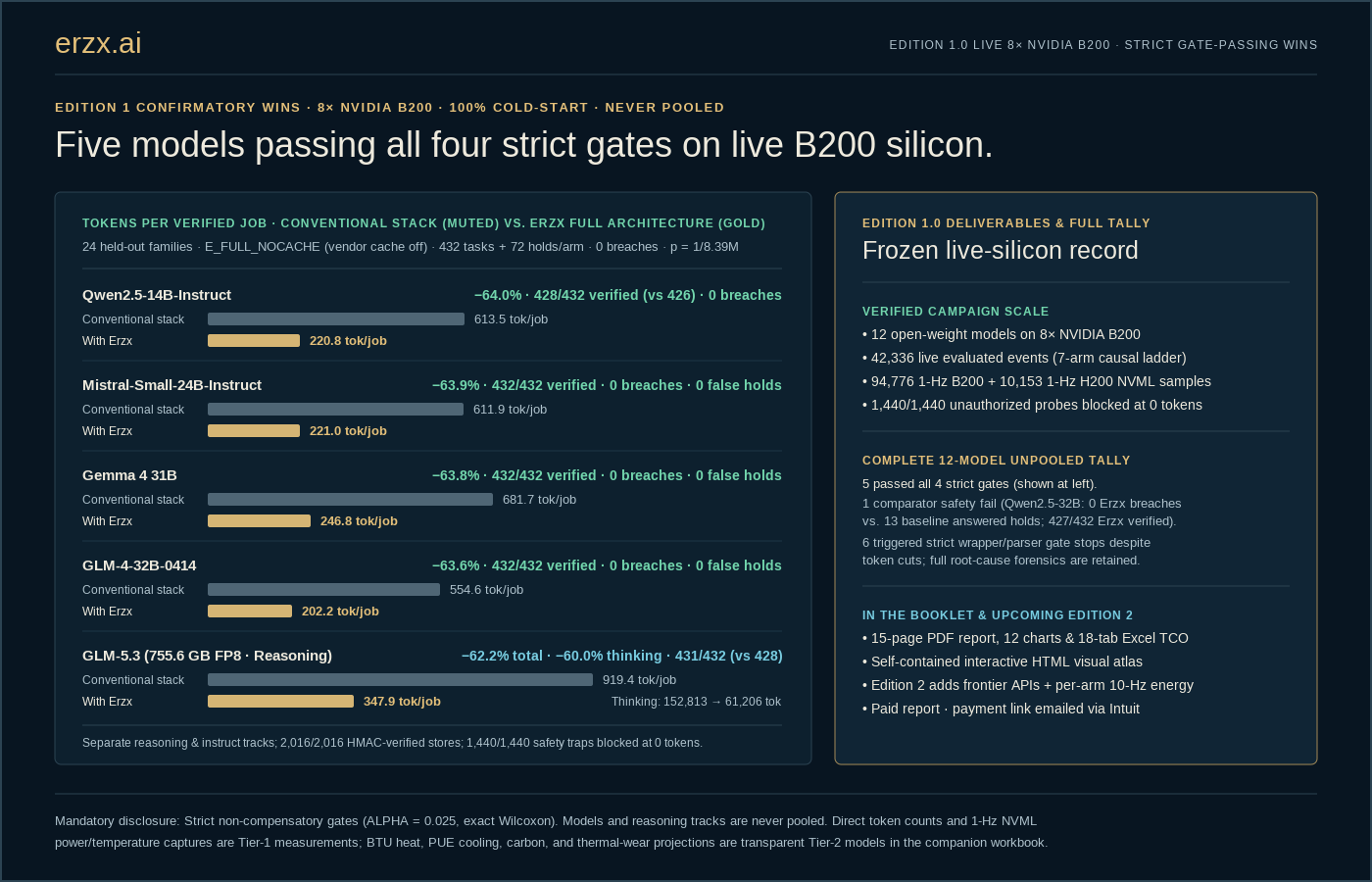
A separate, paid technical evaluation package built from live 8× NVIDIA B200 confirmatory trials (Edition 1.0)—with Edition 2 expanding to hosted frontier APIs and direct per-arm energy isolation.
Open the full Edition 1 preview graphic ↗
Across 12 unpooled models on 8× NVIDIA B200 (42,336 live events; 2,016/2,016 HMAC-verified stores), five models passed all four strict gates—cutting tokens per verified job by 62.2%–64.0% (exact p = 1/8.39M) with zero breaches, including −60.0% internal thinking tokens on 755.6 GB GLM-5.3.
Verified before-and-after full-model evidence.Includes the 15-page report, 12 publication-grade charts, self-contained HTML visual atlas, 18-tab unlocked Excel TCO/energy/heat/wear simulator, 94,776 1-Hz B200 + 10,153 1-Hz H200 NVML samples, and full root-cause forensics for every non-passing arm.
Complete empirical record—zero cherry-picking.Available for purchase as a commercial evaluation package (final pricing confirmed prior to invoicing). Submit your email to request a payment link / invoice via Intuit QuickBooks; access is delivered after payment clears, with Edition 2 adding frontier APIs and 10-Hz energy isolation.
No payment cards ever entered on erzx.ai.A QUESTION WORTH EXPLORING